Ziya Gokalp
Cyber Security Advisor

-
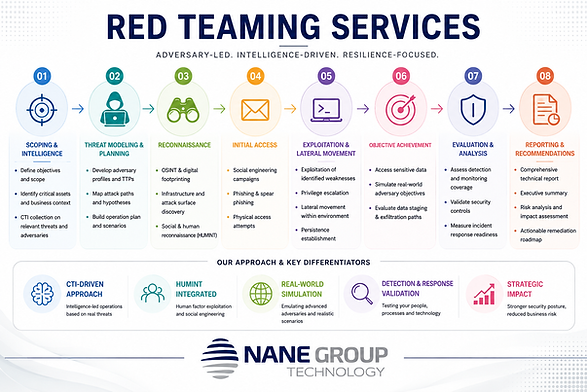
Red Teaming helps organizations: Identify hidden attack paths, Validate existing security investments, Measure detection and response capabilities, Test incident response processes, Evaluate organizational resilience, Improve cyber security awareness, Reduce business and operational risk.
-
Threat intelligence-led Red Team exercises provide an even more realistic assessment by simulating the threats most likely to target a specific organization or sector.

Red Teaming
-
Traditional security assessments often focus on identifying known vulnerabilities. However, modern threat actors do not attack organizations through a single vulnerability. They combine technical weaknesses, human behavior, social engineering, open-source intelligence, and physical access opportunities to achieve their objectives.
-
Red Teaming is designed to answer a critical question: "How would a real-world adversary compromise your organization?"
-
By simulating realistic attack scenarios, Red Teaming enables organizations to evaluate not only their technology stack but also their people, processes, detection capabilities, response procedures, and overall cyber resilience. Unlike traditional penetration testing, Red Team operations emulate the tactics, techniques, and procedures (TTPs) used by advanced threat actors and nation-state adversaries to uncover hidden attack paths and validate defensive capabilities.
-
Modern cyber attacks rarely begin with a firewall bypass or a software exploit alone.